Jmac’s Interactive Fiction page
Interactive fiction is a peculiar medium of videogame that has held my attention longer than any other. While its roots lie in the text adventures of the 1980s, my interest is not nostalgic: I am much more engaged with the modern IF movement, whose authors have been producing work of quality, scope, and experimental spirit that has far outshone anything published during adventure games’ commercial heyday.
This page is primarily concerned with my own interactive fiction and related works. To learn more about the form in general, have a look at the links.
IF games I have created
If you're new to interactive fiction, you may want to have a look at this postcard-sized cheat sheet or this only slightly longer beginner’s guide while trying these games out.
The Warbler’s Nest
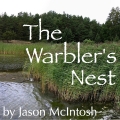 A troubled soul searches for answers among the reeds.
A short, moody work; a thorough exploration should take about half an hour. My most objectively successful game: won the 2010 XYZZY Award for Best Story, and took ninth place in the 2010 IFComp.
Play it, or visit its IFDB page.
You may also wish to visit The Warbler’s Nest’s homepage, which links to reviews, an afterword, and other goodies pertaining to the game.
I've most recently made this game available for iPhone or iPad via the App Store.
Barbetween
An online text sculpture about regret, sharing, and erasure.
Visit the Barbetween homepage.
Calliope
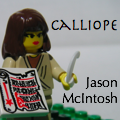 A frustrated author struggles with an absent muse.
I wrote it when I was much younger and extremely confident about my own cleverness, and that’s why it took, uh, twenty-third place in the 1999 IFComp. Despite that, it contains some fun stuff I’m still pleased with. Can also be fully explored within half an hour.
Play it, or visit its IFDB page.
 I have made Calliope’s Inform 6 source code available under a Creative Commons Attribution 3.0 license. I wouldn’t recommend Inform 6 as a language for new authors to start with (see Inform 7 for that), and I can’t speak for the quality of my code from the previous century. But there it is anyway!
A short video about modern IF
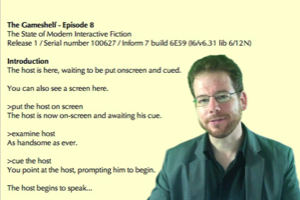
This ten-minute video, which I produced in 2010, examines some recent works, and ponders the challenges that IF continues to face as a game medium at once ancient and novel.
IF creation tools I’ve made
The Inform Extension Search is a simple web-based tool that helps Inform 7-using authors sift through the hundreds of language extensions that the development community has released over the years.
Stuff I (and others) have written about IF
My ongoing blog project The Gameshelf collects plenty of writing about interatctive fiction from myself, my co-blogger Andrew Plotkin, and the occasional guest writer.
Better IF pages than this one
Some solid general introductions to interactive fiction, with a focus on the modern era’s best works and resources for new players:
The People’s Republic of Interactive Fiction’s PLAY page pairs a postcard-sized strategy guide with a short, handpicked list of genre-spanning, beginner-friendly interactive fiction works, all of which are free to play.
Zarf’s Interactive Fiction links to many works by modern master Andrew Plotkin, as well as various other IF-related points of interest around the web.
The Interactive Fiction Database, created by Mike Roberts, is the web’s clearinghouse for all things IF. It lists most every work of IF since the birth of the medium, and invites users to contribute new entries, reviews, and other commentary. It provides assistance for downloading and playing most of the games it knows about, and also offers in-browser play when available.
The Interactive Fiction Community Forum acts as the central web-based discussion space for the IF community. A glance at its “view active topics” page shows the what folks are talking about at the moment, but the whole board is worth exploring, and fresh topics are always welcome. The forum is maintained by Mike Snyder and moderated by a team of community volunteers.
 jmac@jmac.org
 @jmac@masto.nyc